Buddhist architecture in the Kamakura period ()
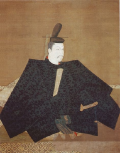
Following his victory in the Genpei War (), Minamoto no Yoritomo founded a feudal system based in Kamakura, with himself as shogun or supreme military commander ruling on behalf of the emperors, who retained only symbolic authority. With power now in the hands of a military ruling class, the earlier emphasis on delicate, refined beauty in art and architecture now gave way to a focus on simplicity, strength and realism.
During the early Kamakura period a new style of Buddhist temple architecture known as
daibutsuyo (also known as
tenjikuyo or ‘Indian style’) was brought to Japan from southern China by a priest called Chogen (1121–1206). This style of architecture took its name from the Daibutsu (Great Buddha) sculptures, best-known of which was the 8th-century Daibutsu of
Todai-ji Temple in Nara, and is represented today chiefly through Yoritomo’s reconstruction of that temple, which had been burned down in the clan wars.
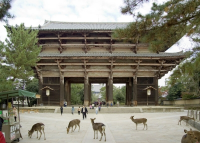
Today all that remains of this reconstruction is the Great South Gate (Nandaimon), a monumental structure with a massive roof supported by a multi-tiered bracketing system. The only other
daibutsuyo-style building to have survived to the present day is the Amida Hall (1194) at Jodo-ji in Hyogo Prefecture.
The Kamakura period also witnessed the growth of Zen Buddhism, which was introduced from China by Myoan Eisai (). Eisai founded the Rinzai school in 1191, and soon after a second Zen school known as Soto was established by Eihei Dogen (). Teaching that through meditation and self discipline one could escape suffering and the circle of reincarnation to achieve a state of enlightenment, Zen Buddhism was characterised by a discipline and practical approach which appealed strongly to the military classes.
During the 13th century, under the patronage of the Kamakura Shogunate, Eisai and his followers established ‘five great temples’ in Kyoto –
Kennin-ji Temple (1202),
Tofuku-ji Temple (1236),
Tenryu-ji Temple (1339),
Shokoku-ji Temple (1382) and Manju-ji (late 13th century) – and another 'five great temples' in Kamakura –
Kencho-ji Temple (1253),
Engaku-ji Temple (1282),
Jochi-ji Temple (1283),
Jufuku-ji Temple (1200, converted to Zen Buddhism in the late 13th century) and
Zuisen-ji Temple (1327). Meanwhile in 1244 Dogen built
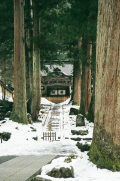
Eihei-ji Temple in the mountains of present-day Fukui Prefecture. During this period Zen monks came to occupy positions of political influence and became active in literary and artistic life, while the Zen monasteries became important educational as well as religious centres.
The Zen architectural style - zenshuyo, also known as karayo or ‘Chinese style’ – brought new principles of temple construction from China. Regrettably little now remains of Zen temple architecture from the Kamakura period, although reconstructed buildings are considered to be quite faithful to the original design.
The typical Zen temple is symmetrical in plan with the main buildings arranged on a central axis. Each hall is set on a stone platform, and the pillars, bevelled at both ends and taller and more slender than those of previous styles, sit on carved stone blocks or plinths (
soban). The tiled roof is usually of hip and gable (
irimoya) design with curving eaves and a lean-to pent roof (
mokoshi) below which gives the impression of a multi-storeyed building. Eaves brackets are positioned not only above the pillars but also on the wall plates between them. Doors and windows are frequently cusped.
Examples of buildings in the mature Zen style include the
raido (worship hall, 1352) at Eiho-ji in Tajimi, Gifu Prefecture; the three-storey octagonal pagoda (14th century) at Anraku-ji at Bessho Onsen, Nagano Prefecture; the Jizodo (Jizo hall, 1407) at Shofuku-ji in Tokyo; and the
shariden (relic hall, 15th century) at
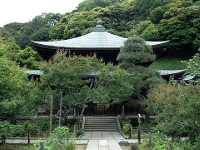
Engaku-ji Temple in Kamakura.
In the face of these new imported foreign styles, existing Japanese temple architecture, adapted under the Shingon, Tendai and Pure Land (Jodo-shu and Jodo-shinshu) sects to suit indigenous tastes, became known generically as wayo (‘Japanese style’) in order to differentiate it from the Daibutsu and Zen styles.


