Cambodian filmmaking up to the 1970s

While documentary films were shot in Cambodia by foreign cinematographers as early as the 1920s, indigenous filmmaking did not begin until the 1950s, when pioneering silent movies were made by several young filmmakers who had studied film overseas, notably Roeum Sophon, Ieu Pannakar and Sun Bun Ly. The film training workshops organised by the United States Information Service (USIS) and the equipment provided by the US for film making seem to have been quite influential during this period. One of the first films made by Cambodians to be screened widely comprised footage of hill tribes (
Dan Prean Lbas Prich, ‘Footprints of the Hunter’) shot by off-duty military personnel using American equipment.
Shortly thereafter, Sun Bun Ly presented his first film Kar Pear Prumjarei Srei Durakut (‘Protect Virginity’) and established the first private movie production company, Ponleu Neak Poan Kampuchea. The success of Sun Bun Ly’s movie inspired other Cambodians, such as Ly Bun Yim, to begin to try to make movies. The 1960s saw the founding of several other local movie production companies as well as the establishment of more movie theatres throughout the country.
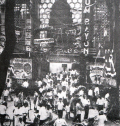
During the 1960s movie tickets were relatively affordable, although the audience for various types of movie seems to have been divided along social lines. European films were extremely popular with students and educated white-collar workers, while the audience for locally-produced Cambodian movies is retrospectively described as ‘farmers and labourers of the working class’.
Favourite Cambodian films from this period included Lea Haey Duong Dara (‘Goodbye Duong Dara’) and Pos Keng Kang (‘The Keng Kang Snake’) by Tea Lim Kun and Sabbseth and Au Euil Srey An ('Khmer After Angkor') by Ly Bun Yim.

Prince Norodom Sihanouk also began making films during this time, primarily in the fiction genre. A cinema-lover since his student days at the
Lycée de Saigon in the 1930s, Prince Sihanouk completed his first feature
Apsara in 1966 and subsequently shot eight other films during the next three years, serving as producer, director, writer, composer, and even sometimes as an actor. His other well-known works during this period include
Ombre Sur Angkor (1967) and
Rose de Bokor (1969).
In many of his films, Sihanouk employed a central love story as a dramatic device or ‘guide’ to illustrate a particular theme about the Cambodian nation. His intention was to give Cambodia’s masses a different glimpse of their country to the one they faced in their everyday lives, ‘revealing its countryside, its temples, its problems, its way of life, its way of thinking, and the faults or weaknesses of other more fortunate fellow countrymen.’

During the unrest of the early 1970s, refugees crowded the cities and provided eager audiences for films; thus, despite the encroaching war, film production continued and movie-going remained extremely popular. It was only in late 1974 and early 1975 that movie house owners began to close their establishments when the public became too scared to venture out for entertainment.
During the Khmer Rouge era some films were made, possibly with Chinese technical aid. Survivors of the regime remember that films were occasionally screened at collective meetings. These films emphasised the effort necessary to ‘develop’ Democratic Kampuchea, and showed primarily workers in the countryside and in factories in Phnom Penh. Films were also made during official visits, either by other heads of state to Phnom Penh or by Khmer Rouge leaders abroad.
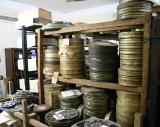
After the end of the Khmer Rouge era in 1979, movie houses in Phnom Penh were re-opened almost immediately. However, there was no domestic film industry left, since many of the filmmakers and actors from the 1960s and 1970s had been killed or had fled the country. Negatives and prints of many films were destroyed, stolen, or missing. Money and equipment for making films were non-existent. Lacking any kind of existing domestic film product, the new government showed films from Việt Nam, the Soviet Union, the Socialist Bloc of Eastern Europe, and occasionally from India. Hungry for entertainment of any kind, moviegoers flocked to the theatres, even though most of the films consisted of clichéd socialist propaganda fables or romantic dramas about lovers struggling against class boundaries.


