Lakhon pharak pharam - Lao classical music and dance
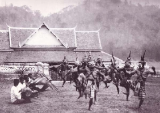
Classical music and dance in Laos is generally believed to have originated with the attempts of the rulers of Lane Xang to replicate the glories of Angkor in their own dominions.
King Fa Ngum, founder of Lane Xang, grew up in the Khmer court and would have been familiar with the female dance and masked male dance and their accompanying gong-chime ensemble as an expression of sacral kingship, so it is understandable that he would wish to introduce the same conventions to his royal palace at Xiang Dong Xiang Thong (Luang Prabang).
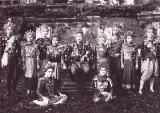
As in neighbouring Siam, the Khmer instrumentarium was subsequently appropriated and a repertoire of courtly performance devised, based on the
devaraja or god-king ideology. By at least the 16th century a Lao version of the
Ramayana known as the
Pharak Pharam had been commissioned to serve as source material.
In subsequent centuries, as Lane Xang itself broke up into the smaller kingdoms of Luang Prabang, Vientiane and Champassak, the court theatre of Siam - also based on the Khmer model but steadily developing its own unique characteristics - became the ascendant source of artistic inspiration for the Lao courts. This is apparent from the close affinities which exist between the styles and repertoires of the surviving classical dance troupes of Vientiane and Luang Prabang.
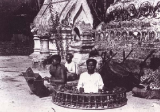
During royal times the standard Lao court ensemble was more or less identical to its Siamese counterpart and was indeed known by the same name -
piphat. Centred on percussion instruments, it typically included various-sized graded gong carillons arranged on circular rattan frames (
khong wong), small and large bamboo xylophones (
ranat), cymbals (
sing,
sab), numerous types of drum (
khlong), the wood or bamboo flute (
khoui) and the double reed oboe (
pi).
After 1975 the khene was integrated into the piphat in order to give it a uniquely Lao flavour and the modified ensemble was given the name mahori. As in Thailand and Cambodia, this name had previously described an ensemble dominated by stringed instruments (such as the two-stringed fiddle of sinitic derivation known as the soh and the three-stringed zither known as the jakhe) which performed at weddings and other community celebrations; its new usage was intended to reflect the role of the modified piphat as an ensemble for the entertainment of all the people.
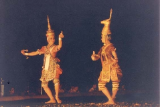
Stylistically, the classical dance (
lakhon prarak pharam) of today, accompanied by the
mahori ensemble, is very similar to its Siamese counterpart, featuring both the female dance
lakhon nai and male masked dance
khon. However, its source, the
Pharak Pharam, contains characteristically strong Buddhist elements and also differs in a number of details from both Siamese and other South East Asian versions of the
Ramayana epic.


